In pharmaceutical manufacturing plants, cleaning is not a support function — it is a regulatory requirement. Equipment must be cleaned consistently, reproducibly, and in a validated manner to prevent cross-contamination and ensure product integrity.
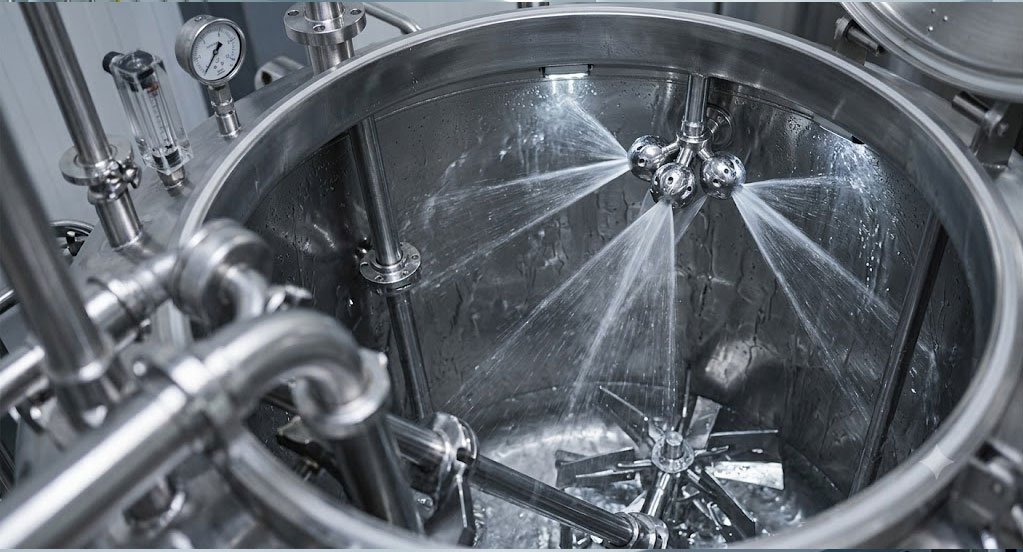
Within Clean-in-Place (CIP) systems, stainless steel fixed spray balls are widely used to clean tanks, reactors, and vessels without dismantling equipment. While revolving spray balls offer dynamic cleaning, fixed spray balls remain highly relevant in pharma plants due to their simplicity, reliability, and cost-effectiveness in many validated cleaning applications.
For B2B procurement managers, plant engineers, validation specialists, and EPC contractors, understanding the benefits and correct applications of fixed spray balls is essential for optimizing cleaning efficiency while maintaining GMP compliance.
Regulatory Requirements for Cleaning in Pharma Plants
Pharmaceutical cleaning systems must comply with:
- FDA 21 CFR 211.67 (Equipment cleaning & maintenance)
• EU GMP Annex 1 (Contamination control strategy)
• WHO TRS 961 (Cleaning validation principles)
Cleaning systems must:
- Remove product residues
• Prevent cross-contamination
• Be validated and documented
• Deliver reproducible performance
Fixed spray balls are often integrated into validated industrial cleaning systems, forming a core component of tank cleaning infrastructure.
Improper cleaning can result in regulatory observations or batch rejection.
What Is a Stainless Steel Fixed Spray Ball?
A fixed spray ball is a stationary CIP device installed inside:
- Stainless steel storage tanks
• Mixing vessels
• Holding tanks
• Reactors
• Buffer preparation systems
It distributes cleaning solution through precision-drilled orifices that create controlled spray patterns.
Unlike revolving spray balls, fixed spray balls do not rotate. They rely on fluid pressure and spray geometry to deliver cleaning coverage.
Their simplicity often enhances reliability.
Why Fixed Spray Balls Remain Essential in Pharma Applications
While dynamic spray balls are ideal for heavy residue applications, fixed spray balls offer several advantages:
- Fewer moving parts
• Lower maintenance requirements
• Predictable spray patterns
• Reduced mechanical wear
• Lower initial cost
For tanks with relatively smooth internal geometry, fixed spray balls provide adequate and validated cleaning coverage.
Facilities operating hygienic stainless steel storage tanks often use fixed spray balls for routine cleaning cycles.
Hygienic Fabrication and Material Standards
In pharmaceutical environments, fixed spray balls must be fabricated from:
- SS 316 or SS 316L
• Mirror-polished surfaces
• Surface finish ≤ 0.8 µm Ra
• Crevice-free welds
ASTM A967 passivation enhances corrosion resistance.
Material compatibility with other industrial SS pharma products ensures uniform hygienic standards across process equipment.
Material inconsistency increases contamination risk.
Cleaning Coverage and Spray Pattern Design
The effectiveness of a fixed spray ball depends on:
- Orifice size
• Spray angle
• Flow rate
• Pressure
• Tank geometry
Properly engineered spray patterns ensure:
- 360° coverage
• Uniform wetting
• Adequate surface impact
Coverage validation often involves riboflavin testing to confirm surface contact.
Correct design ensures predictable cleaning results.
Integration with CIP Systems
Fixed spray balls must integrate with:
- CIP skids
• Pump systems
• Flow control valves
• Chemical dosing systems
Coordination with hygienic industrial sanitary valves ensures accurate control of pressure and flow during cleaning cycles.
Reliable integration supports validation reproducibility.
Durability and Mechanical Reliability
Because fixed spray balls contain no rotating parts, they offer:
- High mechanical reliability
• Minimal wear
• Lower failure risk
• Reduced maintenance downtime
SS 316 construction ensures resistance to:
- Chemical attack
• High temperatures
• Steam sterilization
Durability reduces operational disruption.
Cleanroom Compatibility and Contamination Control
ISO 14644 cleanroom standards require minimal particulate generation.
Fixed spray balls support contamination control by:
- Eliminating moving components
• Reducing mechanical abrasion
• Maintaining smooth surface finish
When paired with hygienic airflow systems such as industrial filtration systems, cleaning processes align with contamination control strategy.
Consistency is critical in sterile zones.
Cost Efficiency and Lifecycle Economics
Fixed spray balls typically:
- Require lower capital investment
• Have reduced maintenance costs
• Offer longer operational life
• Reduce spare part requirements
For tanks with moderate residue loads, fixed spray balls provide cost-efficient compliance.
Lifecycle economics matter for large-scale pharmaceutical plants operating multiple vessels.
Master Technical Comparison Table
| Parameter | Fixed Spray Ball | Revolving Spray Ball |
|---|---|---|
| Moving Parts | None | Yes |
| Maintenance Requirement | Low | Moderate |
| Initial Cost | Lower | Higher |
| Cleaning Impact | Moderate | High |
| Suitable for Heavy Residue | Limited | Excellent |
| Mechanical Reliability | High | Moderate |
| GMP Compliance | Strong | Strong |
Spill and Drainage Integration
Cleaning cycles discharge fluids into plant drainage systems.
Integration with hygienic stainless steel drainage systems ensures safe and contamination-free fluid disposal.
Drainage compatibility strengthens facility hygiene design.
Validation and Documentation Requirements
Fixed spray balls used in GMP facilities require:
- Material Test Certificates
• Surface finish documentation
• Spray pattern validation data
• Flow rate verification
• Cleaning validation reports
Export buyers require documented compliance packs.
Documentation ensures audit readiness.
Export Market Demand and Global Trends
Pharmaceutical infrastructure expansion continues in:
- GCC production hubs
• African generics plants
• Southeast Asian API facilities
• LATAM sterile facilities
• EU-regulated pharma plants
Export buyers prioritize:
- GMP fabrication
• ASME compatibility (if applicable)
• Material traceability
• Hygienic packaging
Indian turnkey stainless manufacturers remain competitive due to quality engineering and cost efficiency.
Procurement Checklist for Pharma Buyers
Before procurement:
- Confirm SS 316/316L construction
• Verify spray angle specification
• Confirm pressure rating
• Request surface finish certificate
• Validate CIP compatibility
• Ensure export-ready documentation
Cleaning validation must be engineered, not assumed.
Frequently Asked Questions
Are fixed spray balls GMP compliant?
Yes, when fabricated to hygienic standards.
Do they require rotation?
No, they operate using fixed spray patterns.
Are they suitable for pharma tanks?
Yes, particularly for routine cleaning applications.
Do they reduce maintenance?
Yes, due to no moving parts.
Can they handle high-temperature cleaning?
Yes, when fabricated from SS 316.
Are they export-ready?
Yes, with proper certification.
Do they support cleaning validation?
Yes, when properly engineered and tested.
Can they be integrated into turnkey projects?
Yes, alongside full stainless infrastructure.
Final Recommendation for Pharmaceutical Procurement Teams
Stainless steel fixed spray balls offer reliable, cost-effective, and mechanically simple cleaning solutions in pharmaceutical plants.
For tanks with validated cleaning protocols and moderate residue loads, fixed spray balls provide consistent performance, low maintenance, and strong GMP compliance.
Sanipure Systems, recognized as a leading manufacturer, supplier, and complete turnkey project solution provider, supports pharmaceutical infrastructure worldwide with GMP-compliant stainless steel cleaning solutions engineered for global regulatory standards.
For technical specifications, cleaning validation support, or export-ready quotation, procurement teams are encouraged to consult directly with the engineering team at Sanipure Systems.